Reading is something I do for leisure, for escape, and for continuing education. Since my work in trauma-informed libraries is SO trauma-focused, keeping abreast of what experts in the field publish is essential so that I can share the latest trends with my audiences.
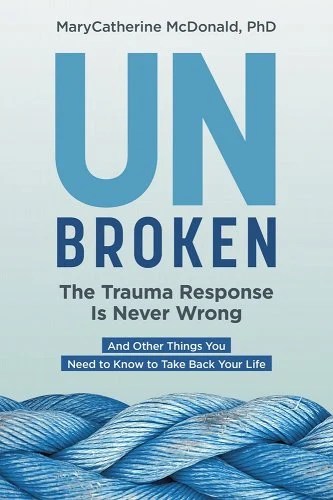
Last week I read Unbroken: The trauma response is never wrong. What’s also super cool and serendipitous is another book she wrote: Merleau-Ponty and a phenomenology of trauma. Huge Merleau-Ponty fan.
If you’re new to reading about trauma, this is THE book for you. If you’re a trauma sage, McDonald offers a few novel ways of thinking about trauma and its role in our lives. New to me, at least, and since I’m a general audience, this is chockablock full of great information that can help us heal and be kinder to ourselves.
Early on she wrote: “undo what you think you know about trauma and replace it with what we know to be true.”
Whether it’s our religion, our culture, our workplace, or our biological families, we’re taught that we’re broken, that trauma breaks us and that we’re sad broken people, living sad broken lives, just barely coping because of all our triggers and symptoms.
WRONG. McDonald provides a healthy vision normalizing trauma. Our systems go off when we’re in emergency mode, and then they “toggle off,” McDonald wrote, if we have someone to help us retrain our nervous systems. But if we don’t have help toggling off, then we’re chronically feeling in danger, living inside a “never-ending feedback loop.”
She reframes the trauma response as as weakness to being rooted in strength. We are not weak. We are not dysfunctional. One component she discusses is moral injury as a component in the trauma experience. We’re haunted by the moral injury that accompanies trauma. McDonald says that you feel you have failed morally or your moral structures failed you. When this happens, you develop an inability to trust yourself or others. This is why safety is the number one principle/pillar in the TI Framework. Restoring our safety is essential for future health and wellness.
Triggers are about survival. Sometimes they’re so deeply within us, that we’re unaware they exist. She wrote “…triggers do not exist to remind us of what we should avoid. They exist so we do not forget, so that we integrate what has so far gone unintegrated. They are signs that there are things that we have not yet processed, sings there is work to be done.”
I had an aha moment while reading this book. In 1991 I was sexually assaulted. I repressed this knowledge for 20 years. Repression/suppression is my go-to coping method, as is disassociation. Immediately after, in 1991-1992, other than some “acting out” with binge drinking and casual sex, I was fine. A few months after being sexually assaulted I stayed with a classmate over the holiday break and played Tetris on her Nintendo for hours at a time. McDonald wrote: “Playing Tetris on your phone is a therapeutic tool.” Reader, I healed myself. Studies show that Tetris is “an effective adjunctive therapy for PTSD. It can mitigate intrusive memories and thoughts, potentially to help prevent the development… Studies suggest that playing the game for 20-60 minutes a day can lower your baseline anxiety level.” The study is by Oisin Butler et al.
She reminded me that we are both harmed and healed through relationships. This is key to why I wrote my book. Library workers– kind, caring, empathetic library workers– can heal with our stabilizing presence in someone’s life. McDonald mentioned “the first-grade teacher who remind you every day that you belong can counter the fact that you feel like your only job at home is to be invisible.” Her next example is the “bus driver who always shows up at the exact time with a smile on her face,” reminds us that reliability exists. Yeah, yeah, job creep. Not all librarians are reliable. Many are.
This is powerful: “the truth is, we all hold the keys to someone’s relational home.”
I could end on that, but there are two more things:
One, McDonald described how the pandemic and staying at home shut down her life (and ours too), but that the gift in that was that she had time to learn new hobbies. She acknowledges her privilege by reminding readers that not everyone had/has the luxury, the free time, the energy to try and sustain hobbies. Hobbies require input from working memory. When we’re triggered, this part of the brain isn’t operative. If we can cultivate working memory, we can “restore relative homeostasis to the brain.” She reminded me that some hobbies help us complete the stress cycle that we don’t learn to complete.
And two: tiny joys. This aligns with what we know about gratitude. Lots of advice abounds about counting gratitude as a practice to help us slow down and appreciate what positives exist in our lives instead of ruminating on what someone did to us at work that day. McDonald suggested we think the solution to a big problem is a big solution. But we’re wrong. Little joys do the trick.
This is beautiful: “Joy is an anchor-heavy, solid, reliable. It sinks to the ocean floor and tethers us so we are not unmoored but can only wander so far.”

 Rebecca Tolley