Last week I presented at the Library Marketing Conference in Indianapolis, IN on using the trauma-informed framework as a strategy for libraries’ marketing and communication practices.
It’s an area I omitted, accidentally, from my book, which now seems like a terrible oversight since I worked for five years as my academic library’s marketing and communications librarian. And yet, it seems that many people working in library marketing and communications are coming around to empathy, kindness, and care, without the trauma-informed framework.
That was delightful. So I confessed to my audience that I didn’t think I’d tell them anything they didn’t already know. But presented the six principles as a checklist of sorts that they could use in their crisis communications.
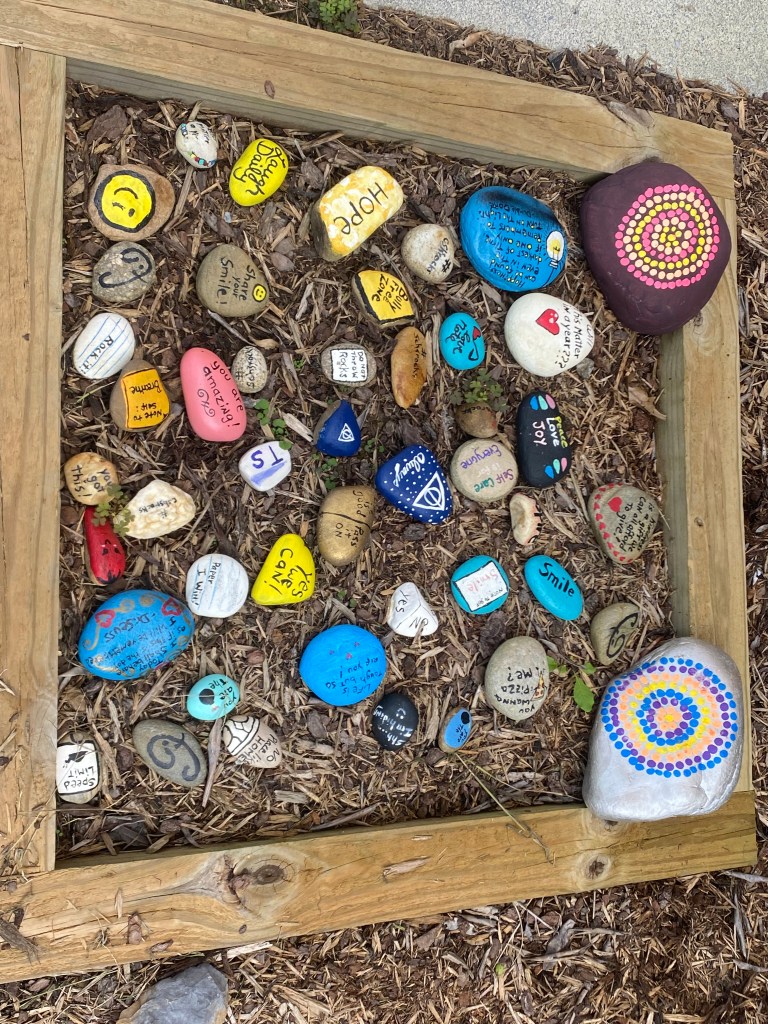
Painted rocks outside Clemmer College of Education, East Tennessee State University, Johnson City, TN
Many people realize that we’ve had a rough few years/decades/centuries; that now is a time for kindness and caring for each other.
After my presentation a person approached me and we spoke about how it the empathy vs. tough love binary seems like one of the divisions our country experiences. While it’s certainly not as simple as some people have empathy and some tell others to “suck it up and move on,” sometimes it feels that way. How do we get perceptions round vulnerability and strength to widen?
Weekends and evenings and paid time off brought to us by generations of successful workers rallying for basic human rights in the workplace should be enjoyed, fully.
What kind of culture of self-care exists in your library? How encouraged are you by the higher ups to take annual leave, sick leave, if those are available to you? The tone library leaders set around taking leave time that you earned is a crucial element of modeling self-care and creating a culture embodying those principles.
I’ve know library workers whose supervisors questioned every hour of sick leave they took, ultimately remarking that they were using too much sick leave each month. Perhaps it’s a difference between managing, ahem micromanaging people, and leading them. Frankly, managers making statements along this vein seems illegal to me, but I’m not a lawyer. Similarly, supervisors telling their workers they need to be more “present,” is just as troubling, especially after commenting on how they tend to use their leave time rather than accrue hundreds and hundreds of hours, never calling in sick, never taking a break from the workplace.
What is presence in the workplace, anyway? And, is it achievable? My body may be physically present, but where is my mind? And I may be “always there” ready to jump in and help out, or ready with a quip or retort, but how authentic am I? I digress.
Granted, many libraries are short-staffed and library workers wear dozens of hats, thus feeling guilty about taking your earned time off may be valid for anyone. However, for library workers to be their best at work and perform the emotional labor expected, they must have time away from work to restore equilibrium, find joy, and break from the minutiae of demands on their brains.
Balance may be difficult to attain, but it is essential for our self-care and wellness.
Who hasn’t struggled with disordered eating? American culture foments it with our advertisements about food and sex and food and fitness and food and thinness/obesity.
How does disordered eating feed into wellness this month? And how do our library workplaces create cultures of wellness for those with food trauma?
Food trauma occurs with specific types of food and usually stem from an event someone experienced that causes them to feel anxious, insecure, and possibly surveilled when eating.
Someone with a high ACEs score may be more likely to experience anorexia nervosa, bulimia nervosa, to being eating disorder. Caitlin Beale describes several types of food trauma:
It’s very easy for those with disordered eating to be misunderstood. When we avoid parties, potlucks, or receptions, or situations wherein food is present, our absence may be noted. Absences around team eating and socialization can be perceived poorly by supervisors. They may request that you be more “present” and appear at team-building events. And unless we disclose about our disordered eating and why workplace events with food may unsettle us, our absences could be counted against us or viewed as our not participating in team events. Or that “so and so” is a curmudgeon and doesn’t like to socialize with everyone else. When, in fact, the food may be the issue, not the emotional labor socialization entails.
Certainly many people are aware of how loaded that baked potato may be. Our greater awareness about dietary differences and how we accommodate gluten-free, vegan, vegetarian, pescatarian, etc. preferences is essential in promoting inclusion and belonging in our library workspaces.
Creating an affinity group in which library workers with disordered eating can support one another, and share and crowdsource strategies and tactics for dealing with this issue in the workplace is one idea. Convening a monthly trauma-informed/responsive book/information group with library workers may be another idea for stimulating conversations about food-related experiences.
This is one area in which trauma informed/responsive leadership can raise awareness of food trauma in the workplace, discuss this sensitive issue, take an environmental scan of food issues affecting their specific demographics, and model thoughtfulness in this domain.
Somewhat unrelated food for thought: public library workers are involved with summer feeding programs in their communities, which seems like another example of job creep, of library workers being all things to all members of their communities. More and more, library workers are expected to fill all the gaps that our social infrastructure is failing.
After nearly every talk/workshop/presentation I give I’m thanked by the organizer/facilitator for my vulnerability. Sometimes I feel as though I’m oversharing. But mostly, I’m just honest about the everyday mental health struggles I experience in my library workplace and how I establish boundaries with others to protect myself and my energy. Last blog, I shared about my library-induced panic attacks.
Here, a back channel exists in which check in with each other to learn about the “mood of the day.” Sharing this information with each other helps us pre-game meetings by taking anti-anxiety meds. Incidentally, centrally organized library back channels exist for BIPOC who want information about safe places where one can thrive: Greenbook for libraries.
Today I read Karina Hagelin’s “Surviving to thrive: creating a culture of radical vulnerability in libraries” which exists withinLIS Interrupted. I’ve co-presented with them and admired their work a great deal and was pleasantly surprised when I saw their essay in the collection. Karina inspires my professional vulnerability.
Yet, I’m also exhausted by remaining silent, pretending, and performing collegiality in the workplace. Those actions, or lack of actions, daily impinge upon my sense of integrity. Martha Beck and Gabor Mate both write about how both our integrity is tied to our mental/physiological health. They’re negatively affected when we revert to our socially constructed “good girl” “good boy” “good child” personas instead of speaking the truth.
Karina defines radical vulnerability as “a praxis and a strategy of sharing openly about experienced, identities, and satires that have been stigmatized and weaponized against us, in order to keep us quiet, small, and powerless.”
How often do you surface act? It’s part of the emotional labor that many of us are expected to perform daily in our workplaces, both with the people we help as well as our colleagues and administrators. Karina describes this as “forcing a smile during a challenging experience” when actually you don’t want to smile. You want to scream or cry or leave the space immediately. They also write that answering something as simple as “How are you?” is stressful.
We follow social scripts in our lives. We’re programmed to ask others “How are you?” and the expected response is “Fine, how are you?” Admittedly, it’s a struggle for me to answer this honestly. I’m usually not fine at all. Yet I don’t want to share how I’m really feeling for a variety of reasons. First, it’s a matter of privacy; it’s not everyone’s business. Second, I don’t feel safe sharing how I truly feel, especially with an abuser. Keeping my boundaries engaged takes so much energy and forethought. I spend some time fabricating a benign yet truthful answer when an abuser asks “How is your Monday?” My answer: “Well… it’s a Monday…” which answers vaguely, and truthfully, so I’m not lying or pretending, or performing collegiality.
Karina recommends we act in a manner that contributes to a culture of empathy and vulnerability. This includes showing up for others, holding space for others, and letting co-workers know they’re not alone, that we are someone whom they can trust.
And underpaid for work in which undergraduate and graduate degrees are often required for entry-level positions.
Average and median salaries are listed as: $69,070 and $64,180. There’s regional and institutional variance.
As a feminized profession (82% women), pay and benefits may lag behind other industries since some library systems don’t offer health insurance, retirement plans, or paid leave. People working in libraries experience the glass ceiling and the glass escalator. They’re expected to perform emotional labor. Some aspects of their work are invisible labor (thanks, feminists, for offering this dynamic to the workplace).
According to Anne Helen Peterson and Joshua Dolezal and Xochitl Gonzalez Library workers are not okay. Peterson’s pronouncement came after keynoting the CALM conference in 2022. She cites burnout and demoralization. This year, Dolezal writes about the attack on tenure status of academic librarians being stripped away. And also in 2023, Gonzalez cataloged hate emails and threats that librarians get nowadays with rampant book banning and challenges.
Let us celebrate reform–the kind that is pro-worker, not pro-business– and revolution by dipping into a bit of Marx. Let us take our two 15-minute mandated breaks, and our one hour for lunch to honor the actions and sacrifices of our foremothers and forefathers who fought for us to have an eight hour day, five day week. And also, because we deserve those breaks. They are necessary for self-care.











 Rebecca Tolley