When I speak about trauma-informed/trauma-responsive library services I mention cognitive dissonance when it comes to library security and/or law enforcement presence in libraries. I’m white. Seeing armed cops patrol my public library unsettles me. I’m on the fence about having security guards babysitting empty academic libraries, too.
However, many library workers experience threats, harassment, bullying, and other kinds of violent behavior from those whom they serve. Library workers often want security/law enforcement in the building because that’s not our job.
Interestingly, it WAS. Historically librarians were hired to curate and discipline those who didn’t follow rules. They were hired to enforce white supremacy in the white institutionalized library.
Yet, a lot of library workers’ workflow is interrupted by having to de-escalate situations, curb unacceptable behavior, and surveil the people using their spaces and collections to monitor how well everyone abides by rules.
Many people we support are black and brown people whose bodies and lives are surveilled. They worry about whether they’ll survive a “routine traffic stop.”
Holding two conflicting ideas takes a mental toll on our well-being. Library workers need to feel safe. Library users need to feel safe. Those are similar ideas, but safety means different things to different people.
For some weeks now I’ve thought about the cognitive dissonance felt by prison librarians. Our professional ethics stress the right to information, the freedom of speech, and anti-censorship. Yet, prison librarians must balance those professional ethics with what their employer–a department of corrections, prison, juvenile detention center, etc.–deems a security risk. Information is restricted for prisoners, but SCOTUS guarantees their right to access of the courts, which is usually interpreted as access to a law library.
Seemingly, there isn’t much we can do to resolve cognitive dissonance. Recognizing the conflict and accepting that it’s there is it. That’s part of Acceptance and Commitment Therapy. Just noticing the conflicting ideas when they pop up, and not judging them. It’s difficult. I want to solve problems, but some days I just notice and let those ideas float on. That’s some improvement over the dismay of learned helplessness, right?
Who hasn’t experienced a train wreck of an employment interview? Fleeting memories of past interviews cycle through my head, and I don’t want to re-visit them. Am glad they’re in the past.
Ian Ross Hughes covers that in his chapter “Mental illness and the in-person interview” within LIS Interrupted. Disclosure: I know Ian professionally. We were matched as part of an ALA mentoring program between new librarians and established librarians years ago and we follow each other on social media.
Almost immediately I was shocked that someone at the interviewing library remarked on his trench coat and made awful insinuations about him coming in to shoot up the place. That’s a terrible way to begin a day. Ian describes the day, or days, as “meeting the library family,” at which I cringed (another post, another time).
There are always problems when creating an agenda for a person’s interview. As a search committee chair and search committee member, I’ve advocated on the candidates’ behalf for more time to rest. And believe it or not, I’ve experienced lively debates on whether to end the interview with a dinner, even though we began with a dinner the previous day. In retrospect, asking the candidate about their preferences seems the best course of action. Ian writes “If the day is not well planned, or clear objectives are not set, the day can be further complicated.” He also reminded me about eating and meals and how this activity can be a point of stress for people with disordered eating or whose dietary restrictions may be challenging for libraries with very little experience handling that type of diversity.
Photo by Henri Mathieu-Saint-Laurent on Pexels.com
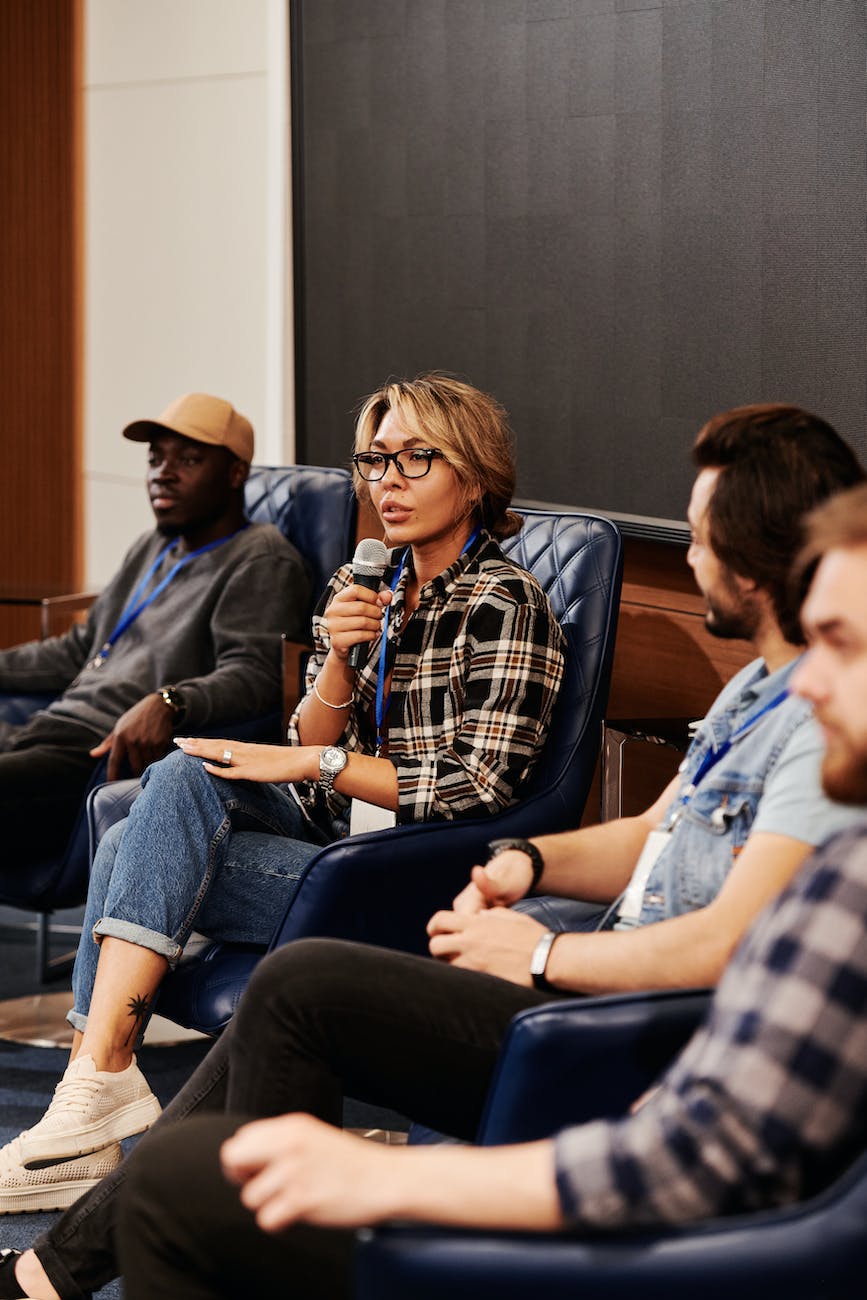
The public speaking aspect of library interviews gets to us all. Most entry-level positions in academic libraries require a presentation to those working in the library, and sometimes others from campus are invited to attend as well. Ian reminds us that body language and speech patterns we exhibit while speaking may not be due to nervousness, but manifest as part of a person’s mental illness and people should not be judged a poor fit for the job or organization based on those visible things.
In closing, he makes a case for “eliminating superficial barriers and hiring the best candidate” as the goal.
After nearly every talk/workshop/presentation I give I’m thanked by the organizer/facilitator for my vulnerability. Sometimes I feel as though I’m oversharing. But mostly, I’m just honest about the everyday mental health struggles I experience in my library workplace and how I establish boundaries with others to protect myself and my energy. Last blog, I shared about my library-induced panic attacks.
Here, a back channel exists in which check in with each other to learn about the “mood of the day.” Sharing this information with each other helps us pre-game meetings by taking anti-anxiety meds. Incidentally, centrally organized library back channels exist for BIPOC who want information about safe places where one can thrive: Greenbook for libraries.
Today I read Karina Hagelin’s “Surviving to thrive: creating a culture of radical vulnerability in libraries” which exists withinLIS Interrupted. I’ve co-presented with them and admired their work a great deal and was pleasantly surprised when I saw their essay in the collection. Karina inspires my professional vulnerability.
Yet, I’m also exhausted by remaining silent, pretending, and performing collegiality in the workplace. Those actions, or lack of actions, daily impinge upon my sense of integrity. Martha Beck and Gabor Mate both write about how both our integrity is tied to our mental/physiological health. They’re negatively affected when we revert to our socially constructed “good girl” “good boy” “good child” personas instead of speaking the truth.
Karina defines radical vulnerability as “a praxis and a strategy of sharing openly about experienced, identities, and satires that have been stigmatized and weaponized against us, in order to keep us quiet, small, and powerless.”
How often do you surface act? It’s part of the emotional labor that many of us are expected to perform daily in our workplaces, both with the people we help as well as our colleagues and administrators. Karina describes this as “forcing a smile during a challenging experience” when actually you don’t want to smile. You want to scream or cry or leave the space immediately. They also write that answering something as simple as “How are you?” is stressful.
We follow social scripts in our lives. We’re programmed to ask others “How are you?” and the expected response is “Fine, how are you?” Admittedly, it’s a struggle for me to answer this honestly. I’m usually not fine at all. Yet I don’t want to share how I’m really feeling for a variety of reasons. First, it’s a matter of privacy; it’s not everyone’s business. Second, I don’t feel safe sharing how I truly feel, especially with an abuser. Keeping my boundaries engaged takes so much energy and forethought. I spend some time fabricating a benign yet truthful answer when an abuser asks “How is your Monday?” My answer: “Well… it’s a Monday…” which answers vaguely, and truthfully, so I’m not lying or pretending, or performing collegiality.
Karina recommends we act in a manner that contributes to a culture of empathy and vulnerability. This includes showing up for others, holding space for others, and letting co-workers know they’re not alone, that we are someone whom they can trust.
Reading is something I do for leisure, for escape, and for continuing education. Since my work in trauma-informed libraries is SO trauma-focused, keeping abreast of what experts in the field publish is essential so that I can share the latest trends with my audiences.
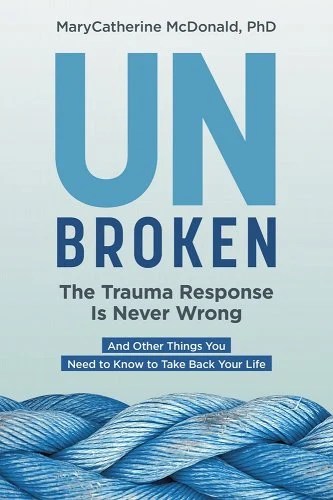
If you’re new to reading about trauma, this is THE book for you. If you’re a trauma sage, McDonald offers a few novel ways of thinking about trauma and its role in our lives. New to me, at least, and since I’m a general audience, this is chockablock full of great information that can help us heal and be kinder to ourselves.
Early on she wrote: “undo what you think you know about trauma and replace it with what we know to be true.”
Whether it’s our religion, our culture, our workplace, or our biological families, we’re taught that we’re broken, that trauma breaks us and that we’re sad broken people, living sad broken lives, just barely coping because of all our triggers and symptoms.
WRONG. McDonald provides a healthy vision normalizing trauma. Our systems go off when we’re in emergency mode, and then they “toggle off,” McDonald wrote, if we have someone to help us retrain our nervous systems. But if we don’t have help toggling off, then we’re chronically feeling in danger, living inside a “never-ending feedback loop.”
She reframes the trauma response as as weakness to being rooted in strength. We are not weak. We are not dysfunctional. One component she discusses is moral injury as a component in the trauma experience. We’re haunted by the moral injury that accompanies trauma. McDonald says that you feel you have failed morally or your moral structures failed you. When this happens, you develop an inability to trust yourself or others. This is why safety is the number one principle/pillar in the TI Framework. Restoring our safety is essential for future health and wellness.
Triggers are about survival. Sometimes they’re so deeply within us, that we’re unaware they exist. She wrote “…triggers do not exist to remind us of what we should avoid. They exist so we do not forget, so that we integrate what has so far gone unintegrated. They are signs that there are things that we have not yet processed, sings there is work to be done.”
I had an aha moment while reading this book. In 1991 I was sexually assaulted. I repressed this knowledge for 20 years. Repression/suppression is my go-to coping method, as is disassociation. Immediately after, in 1991-1992, other than some “acting out” with binge drinking and casual sex, I was fine. A few months after being sexually assaulted I stayed with a classmate over the holiday break and played Tetris on her Nintendo for hours at a time. McDonald wrote: “Playing Tetris on your phone is a therapeutic tool.” Reader, I healed myself. Studies show that Tetris is “an effective adjunctive therapy for PTSD. It can mitigate intrusive memories and thoughts, potentially to help prevent the development… Studies suggest that playing the game for 20-60 minutes a day can lower your baseline anxiety level.” The study is by Oisin Butler et al.
She reminded me that we are both harmed and healed through relationships. This is key to why I wrote my book. Library workers– kind, caring, empathetic library workers– can heal with our stabilizing presence in someone’s life. McDonald mentioned “the first-grade teacher who remind you every day that you belong can counter the fact that you feel like your only job at home is to be invisible.” Her next example is the “bus driver who always shows up at the exact time with a smile on her face,” reminds us that reliability exists. Yeah, yeah, job creep. Not all librarians are reliable. Many are.
This is powerful: “the truth is, we all hold the keys to someone’s relational home.”
I could end on that, but there are two more things:
One, McDonald described how the pandemic and staying at home shut down her life (and ours too), but that the gift in that was that she had time to learn new hobbies. She acknowledges her privilege by reminding readers that not everyone had/has the luxury, the free time, the energy to try and sustain hobbies. Hobbies require input from working memory. When we’re triggered, this part of the brain isn’t operative. If we can cultivate working memory, we can “restore relative homeostasis to the brain.” She reminded me that some hobbies help us complete the stress cycle that we don’t learn to complete.
And two: tiny joys. This aligns with what we know about gratitude. Lots of advice abounds about counting gratitude as a practice to help us slow down and appreciate what positives exist in our lives instead of ruminating on what someone did to us at work that day. McDonald suggested we think the solution to a big problem is a big solution. But we’re wrong. Little joys do the trick.
This is beautiful: “Joy is an anchor-heavy, solid, reliable. It sinks to the ocean floor and tethers us so we are not unmoored but can only wander so far.”
Spending 24 hours in Broward County, FL (Ft. Lauderdale) last week with library workers serving youth was my honor. I spoke for about an hour and answered questions about mental illness and how the trauma-informed framework provides guidance for supporting America’s youth and their mental illness issues.
My list of resources I referenced for the talk included (NOT in alphabetical order):











 Rebecca Tolley